
See You ; See Me I - Asian Palm Civet
Up Close & Personal With The Civet Finally
CIVETS
Aniruddha Bhattacharya
6/2/20266 min read
Pobitora Wildlife Sanctuary ; Assam
A glance here, a tail there and one sighting of a scampering, small catlike creature was all that I had managed to see of these guys in my trips to the woodlands until I reached Pobitora a few months ago. In fact, they hadn’t even given me a chance to reach for my camera in all my missed sightings of the species. They were always there one moment and gone the next and I wasn’t the only one with this experience with these guys despite their recorded presence all around the country. Pretty much everyone who I’d spoken to had recalled a similar experience with these guys who are just famous for being “difficult” subjects in the wildlife circles. They’re shy, fast, nocturnal and they stay in the canopy which makes them difficult to photograph. Now, I don’t know what it was that made me guess that the trip to Pobitora would perhaps bring me decent photos of these guys but I had a feeling somehow which was probably based on the fact that this sanctuary did not have many predators for smaller creatures. There are no big cats in Pobitora currently and even the Jackals whom I discovered there are not active in the trees where these guys spend their time mostly and I was hoping for the best really when I asked Umesh, my guy there if there was a chance of Civet sightings to which he nodded thoughtfully but didn’t really promise anything as a reply. His nod though, kept me hopeful for the best given that he had delivered so well on the Barbets as I wrote here in “Polychromatic Life”.
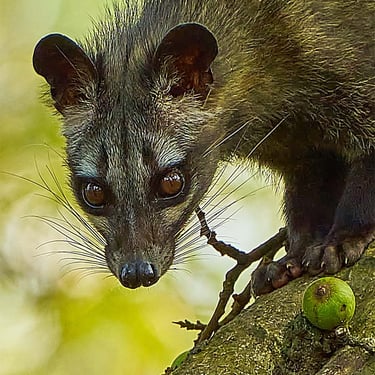
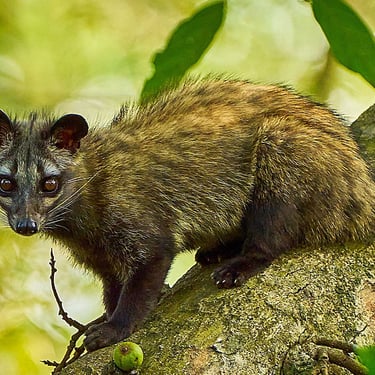
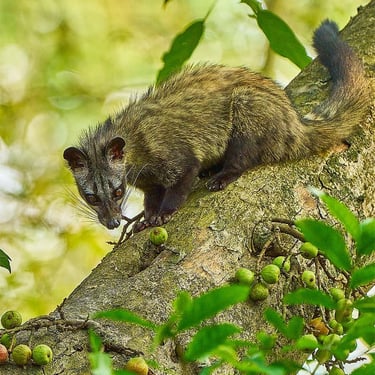
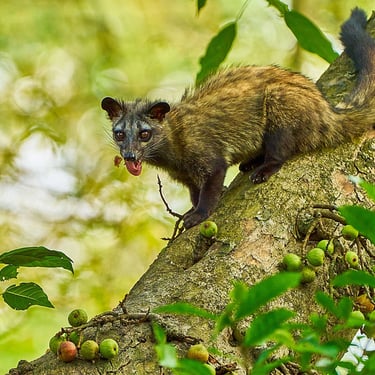
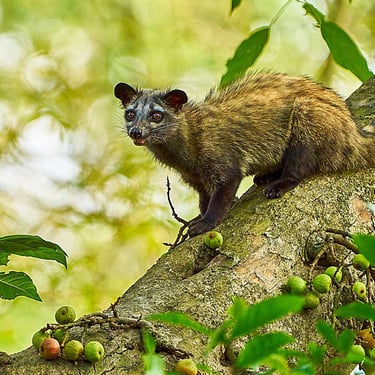
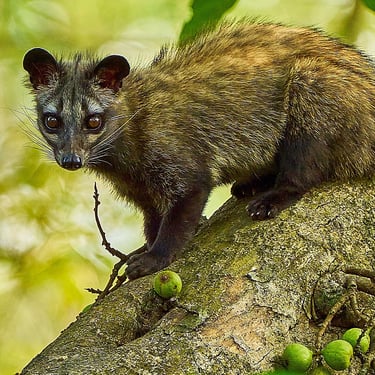
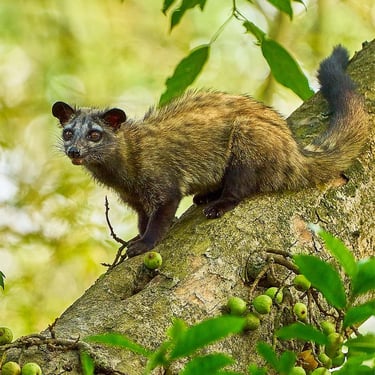
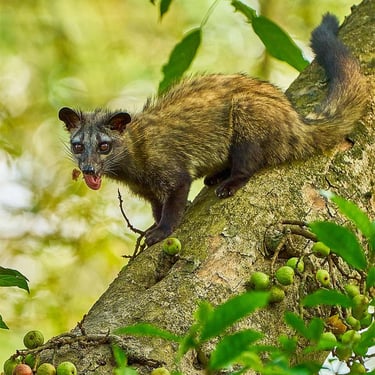
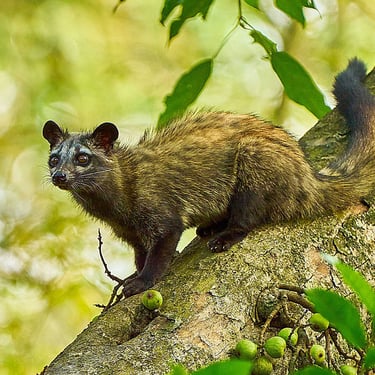
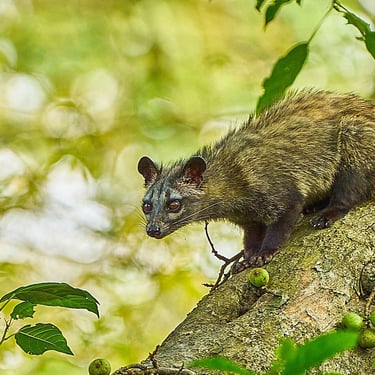
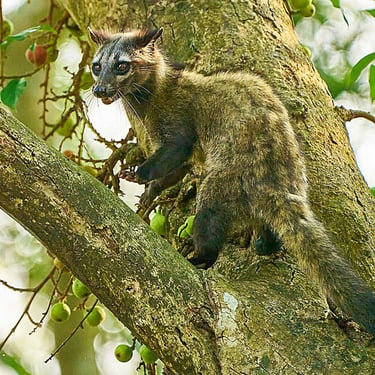
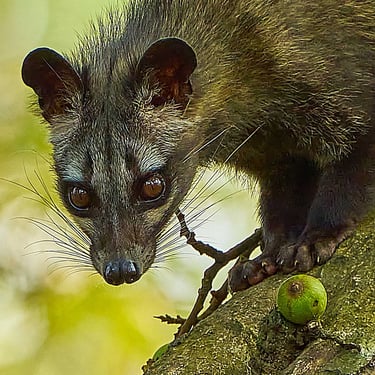
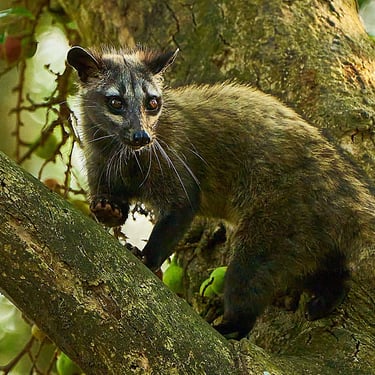
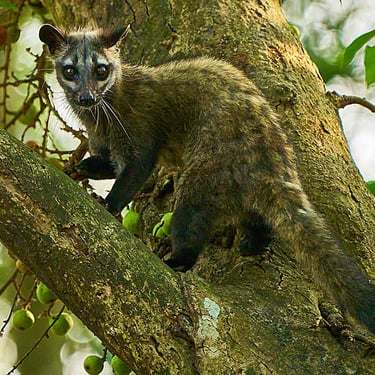
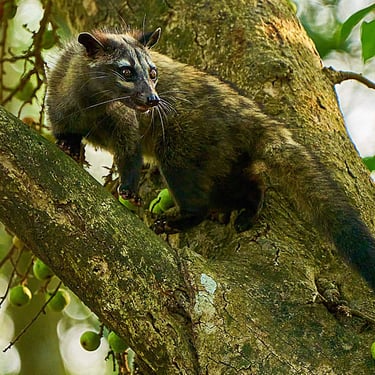
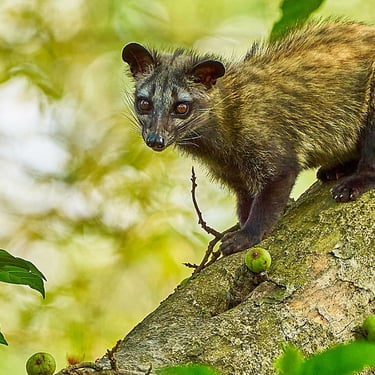
My previous posts about this open access meadow of a sanctuary have ranted on about how much I loved the easy and close access to subjects here and well, the same was in play when Umesh slowed his vehicle by the side of the stream that passes through the place and asked “You smell that ?” I actually didn’t catch the smell right then cause I was distracted by his hurried actions as he sped up again and then parked all of a sudden and pointed with his nose and added “What’s that there ?” I stared out at the direction immediately then and mouthed, “Civet !” when I saw my guy in these images on a tree right in front of us. I’d seen enough images to know that beautifully painted face and so happy to have finally met the creature that had eluded me for so long and here he was, just staring right back at me curiously and with no inclination of scampering off as was usually the case. Those eyes man ! Never did I imagine staring into such differently gorgeous brown eyes. What a beauty the Asian Palm Civet turned out to be really and our first meeting was under such beautiful conditions. The light was good, there was no clutter around, the background was beautiful, my subject was chilled out where he had food and water in his immediate vicinity and the dance was such a joyous one for me. I absolutely just loved this sighting.
Civets are hard to find cause of their inherent nature and lifestyle choices. These guys have had us confused about their lives for a while now and even their scientific name shows that. The scientific name of the Asian Palm Civet is Paradoxorus hermaphroditus and just that should pretty much say it all really. The crafty buggers actually had us believing that they were hermaphrodites for the longest time. Remember the smell that Umesh mentioned when we approached my guy here? Well, the smell caught up to me as I was photographing my guy and its pretty distinct and pungent. As it turns out, both the genders among these guys have a scent gland near their privates which gives out a very unique odour. It’s the same scent gland that had us believing that all of these guys have testicles and hence the confusion. It’s this very scent gland that helps this species communicate by giving off odour and is also one of the reasons why they are coveted by perfumers. Civet musk has been valued for centuries in luxury perfumery and much to the plight of these poor creatures. The musk was traditionally squeezed from the glands of these poor guys and we’re told that the perfume industry has since moved on to synthetic alternatives but we’ve seen how centuries of persecution can effect the behaviour of certain species like the Nilgiri Langurs whose behaviour is totally opposite the behaviour of Lion Tailed Macaques who they are neighbours of due to different conditioning over time which I wrote about in “Valparai Surprise I”. I’m not claiming here that persecution for their musk is the sole reason for the skittish behaviour of these beasts around us Humans. I’m just saying that every experience adds to the information we pass down to the next generation generally and these guys are pretty much fodder for any other beast that can access the trees including Humans who may be after them for their musk.
My guy here is also famously nocturnal. In fact, most of the pictures of them out in the wild are shot at night and this aspect of their nature adds to their elusive nature with regards to our sightings of them. Most of the reserves are shut at night when these guys come out to play. I lucked out with my guy here cause they are known to chill during the day and often in trees where they have food nearby which is just the case here. I just caught my guy in the middle of his afternoon chill out and that was pretty much how he behaved on seeing me as well. My guy’s movements were slow and unhurried and he didn’t seem threatened by our presence at all as he ended the sighting when he just dozed off after changing his position from one tree to the next during our meeting. This guy was not intimidated by safari vehicles at all that day while up in the trees and perhaps that was cause he lives the reserve lifestyle and he did not see us as a threat at all as long as he was in the branches at least. As we left our friend to rest in his tree surrounded by his fruits, Umesh told me that there was another one of these guys around those parts and both were often seen there, by the stream when the trees had fruit on them in the area. Interestingly, Asian Palm Civets are known to pick out ripe fruits easily from a collection of ripe and raw ones and it’s only recently that someone has seen a pair of these guys mate in the wild. Those guys were reported to mate numerous times in the branches and then frolic around for a bit before retiring to their own trees of choice and back to their solitary lifestyles.
The photos in this post are from the first tree where I found my guy chillin in his piece of paradise with food, water and companionship all in his vicinity. I’ll come back to the photos from the tree where we left him at when he decided to rest despite our presence in my next post about these guys along with more about the species. Finding my guy so close to the road was made possible by the unique topography of Pobitora which has totally blown me over. It’s a huge advantage when you’re dealing with creatures like my guy here and would perhaps be a huge disadvantage and danger too if larger predators and big cats were part of the mix here. Pobitora does not have big Cats and Elephants and the open access suits the residents and visitors to this reserve beautifully cause it enables very different photos and videos and gets you up close and personal with usually rare creatures like the Asian Palm Civet. Honestly, I’d never thought I’d see one of these guys from so close and chillin so comfortably around Humans in the daytime and yet here we are and I count myself very lucky to have witnessed and documented it with time enough to actually pay attention to the compositions. I lucked out big time during my short first visit to this sanctuary despite the rain that cut my visit to the place by half and I have every intention of going back to see what other wonders I can find in this little magical meadow by the stream.
I’m certain that this little gem of a sanctuary will have quite a few more surprises for me come a turn of the seasons cause animals and birds do not lay down flags and fences. Many of them call the same area territory and sometimes for just a limited time. The story of the adventures from Pobitora will continue now though with the other lovely creatures that I found there on my first visit and perhaps with more to come in the winter. I hope you stick around to find out how it all goes.
© 2026. All rights reserved.