
The Bone Gulper - Greater Adjutant Stork
Down In The Dumps With The Greater Adjutant
BIRDS
Aniruddha Bhattacharya
5/20/20265 min read
Guwahati ; Assam
The Bone Gulper or “Hargila”, is what people from my side of the woods call these strange birds and honestly that name fits a lot better than how he is referred to in English if you ask me. My dude literally gulps down bones so what’d ya expect? The English speaking though, apparently landed in West Bengal and were stupefied some to see these huge, odd-looking birds with a straight-backed walking gait and proceeded to call it the “Adjutant” based on how the large bird strutted about like a strict officer in the army aka, an adjutant. It probably started off as a joke like the name of the Secretary Bird from Africa and the joke stuck.
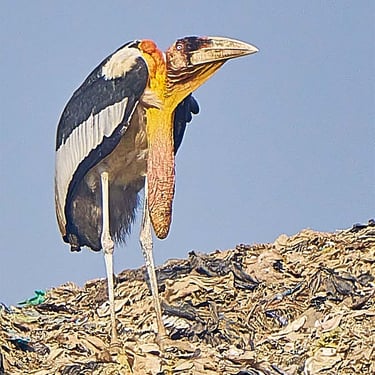
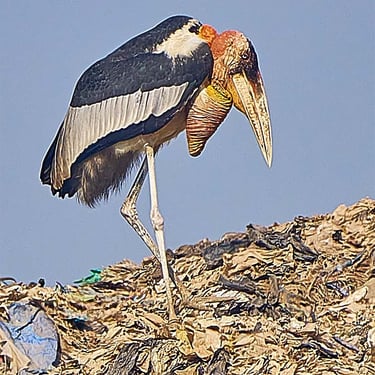
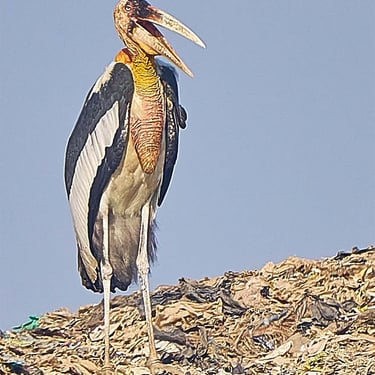
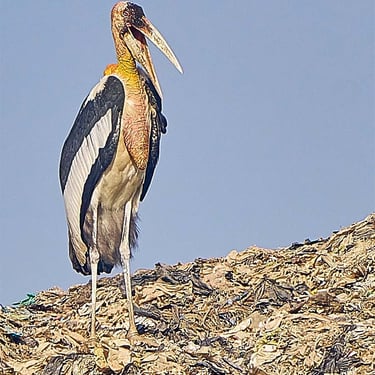
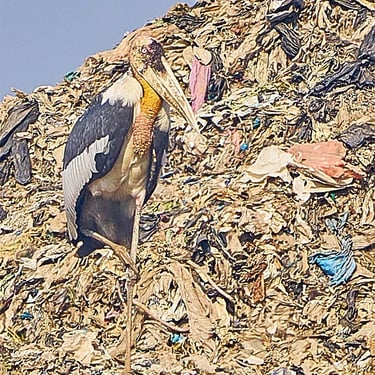
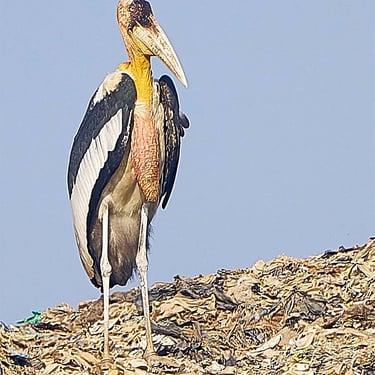
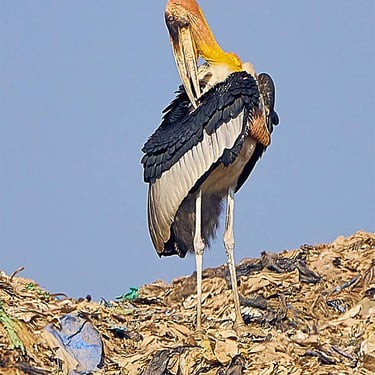
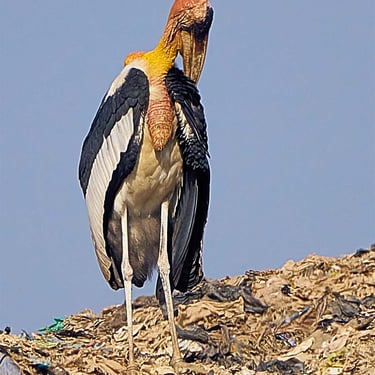
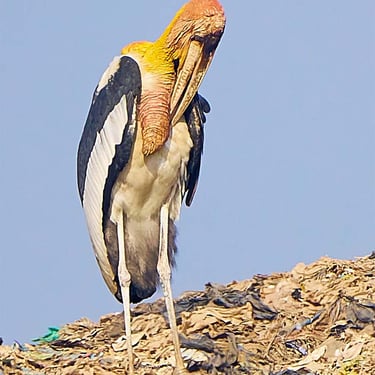
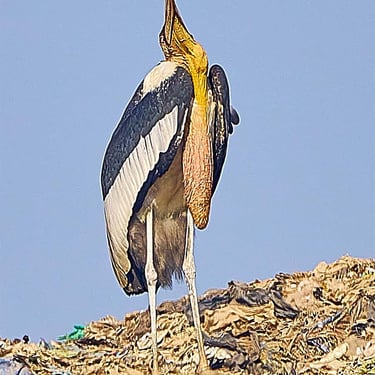
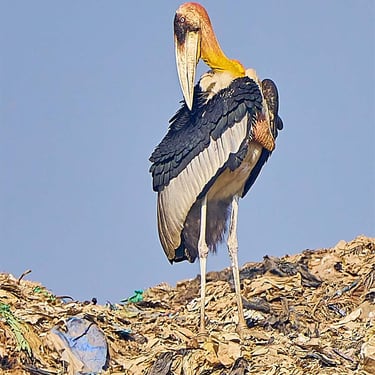
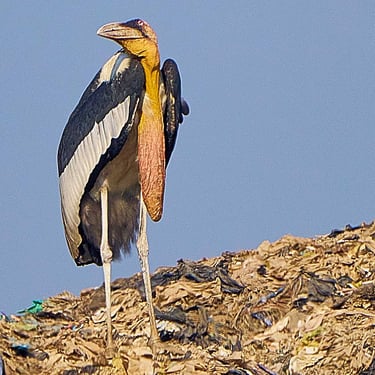
Jokes aside though, these guys are nothing like anything else. I pretty much knew what I was in for theoretically when I finally ran into them a few months ago but they made me pause to get a grip on what I was looking at none the less. They’re unique alright and are pretty tall at almost 5 feet in height. They have an odd neck pouch and everything about these guys just screams Scary, Prehistoric Danger to me. They are not a pleasant sight the first time around for us Humans by a long shot and then some. They are big, scary, ugly creatures and totally reaffirm my conviction that big birds with such big beaks are the scariest and most unpredictable creatures that you could run into and are probably capable of inflicting a lot of pain and hence I choose to be careful around em. They’re an endangered species though and I could have gone back for more pictures having found em so close to my home but I just didn’t have the stomach for it in all honesty. I’m also not really sure if it was a bad thing that they were so far away when we met. The fact that I’d found em at a local garbage dump didn’t really help either though. The place didn’t have any photographic appeal; the garbage is in the pictures as you can see and the stench there made breathing difficult. That said, I’m not too sure if I’d get close to one of these guys even if I was given the opportunity at a different location to be honest. Just the thought makes me shiver a little at the small of my back. But like it or not, that local garbage dump is probably one of the last places to see these guys around these parts and well that’s done for me now at least. I do hope on finding them in a different and not so rancid environment the next time around to find out how that goes at least. I am curious to learn how they’d react to an approaching vehicle as I do not intend to be out of a vehicle when I’m around these guys for sure. Just look at em man ! So scary !
Our “Hargila” aka, The Greater Adjutant is a scavenger. It’s cousin, the smaller Lesser Adjutant is also found abundantly in Assam and near water bodies in pretty much all of the reserves and protected sanctuaries in the state. Both species probably descended from the same scavenging parent and while the Greater Adjutant retains that preference for a means of livelihood, it’s smaller cousin although mostly bald still ( a trait seen in scavenging birds ), has shifted to a life of wading along the water for a life of fishing for its meals. The larger, Greater Adjutant also has that odd neck pouch that we still cannot seem to figure out the use for even today and is a characteristic that this species shares with the African Marabou Stork. In fact, the Marabou Stork and the Adjutant cousins pretty much make up the whole genus that they are a part of with our friend the Greater Adjutant being the rarest find of the lot these days. All of these birds retract their necks while flying unlike other Storks and it’s probably the heavy burden of their larger weapons of mass destruction that make them do that and stand apart from the others. My visit to the garbage dump where I found these guys was motivated by a search for Vultures actually whom I didn’t find there. In fact, the visit brought out the current trends seen in the aerial scavenging business in the country for me which I mentioned in “A Dark Knight Rises”. The Vultures are gone and have been replaced by Black Kites. These big guys remain though and guard their mountains of trash easily still with their domineering presence. They’re just too big for the Kites to take on yet but their numbers weren’t large and you can rest assured that the smaller and more flexible Kites will be ready to move in if their numbers fall further. It’s interesting to note here that these birds have no predators. No one dares. Their evolution got them to the peak of a certain ladder of development. It’s interesting though that they aren’t going extinct today for any fault of their own really. The success of Humans pretty much just changed the rules of the game for them. Makes you wonder though doesn’t it?
These guys were once found easily in South and South East Asia. Today, there are just three breeding populations left. Two of those are in India and the third is in Cambodia. The world has moved on for larger birds in general and more so for larger scavenging birds who are also hated by Humans. Smaller creatures that can manoeuvre around the Master race now do better in the world shaped by Humans and we can see that easily in the rise in numbers of smaller Raptors like Kites and Shikras. Even the mammals that remain in our reserves need the protection of Humans from other Humans. It’s just how it is. Our influence over everything including the environment makes it all our responsibility and yet perhaps we do not comprehend that responsibility. But then again, perhaps we just were not designed to comprehend and shoulder that responsibility in the first place. Perhaps it’s just beyond us and that is something that I am honestly just perhaps starting to realize. Who knows man? 90 percent of the species that have ever lived are extinct now. Nothing special in that at all if you look at it with the scale and scope of the planet as a whole in mind. That doesn’t mean we shouldn’t try though cause our existence is tied to the cycle that all creatures are a part of and you know what happens if the actual big system holding our many man made systems together collapses? Mother Nature usually provides for a replacement cog whenever we inadvertently knock a cog out of place in this system. Let’s just hope that we don’t do something stupid that knocks the whole wheel down. As far as our Bone Gulper is concerned, there are a few hundred of these guys still around and if you want to grab a look at these guys, right now would probably be a good time to get it out of the way like I did and the garbage dump on the highway in Guwahati still draws these guys as of Winter 2025.
It’s no secret that I didn’t relish that trip to the dump. It sucked being in the dumps man. The smell was rancid, the subjects were far away and most importantly, the garbage ruined the photographs. In hindsight though it was a very fruitful outing because it tied together the various stories about the scavengers of this country that this blog has been talking about in different posts and it was pretty cool how the pieces fit together so easily. Just one look at the scene there made it all fall into place so quickly and beautifully for me. The visit was also special because it introduced me to these heroes of days gone by when the world was a different place and these guys pretty much look like the ancient stories that they have been a part of. Well, you know how I feel about being down in the dumps again but then you never know really do you and there’s always hope that I’ll run into these guys at a prettier location yet. Im staying in the car if it does happen though. That much is pretty sure at least.
© 2026. All rights reserved.