
The Indian Scops Owl's Secret
Evolution & Camouflage Of The Indian Scops Owl & In General
BIRDS
Aniruddha Bhattacharya
12/2/20255 min read
Mulshi, Maharashtra
I thought that I knew this bird. They were the first owl species that I’d seen and photographed after all. I’d seen them often in tree hollows and branches in many reserves around the country with their squinting eyes while we were out on safari. Never shy or even bothered by safari vehicles, these little guys stand their ground firm and with confidence. They’ve accepted our presence just as I’d accepted what I’d seen and had even stopped making pictures of them cause they don’t really do much out in the daytime really. But then, I’d seen them perchance while I was out chasing larger mammals like Tigers who were my gateway into wildlife. Owls come alive at night and my visit to the Andamans in 2024 opened me up to the unique beauty and majesty of these wonderful creatures. All of the owls that I saw around Shri Vijayapuram had many common features which I probably expected to be shared among all of the owls that I’d see around these parts. Thing though is that one shouldn’t ever assume and the Indian Scops Owl, although common had hidden his most effective adaptation from me despite all my sightings of the species. This adaptation makes the species better at nocturnal life than their cousins and was such a wonderful surprise for me when I encountered him at Mulshi recently.
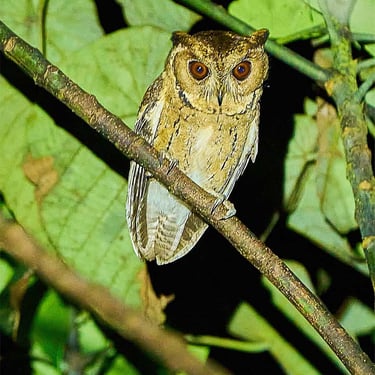
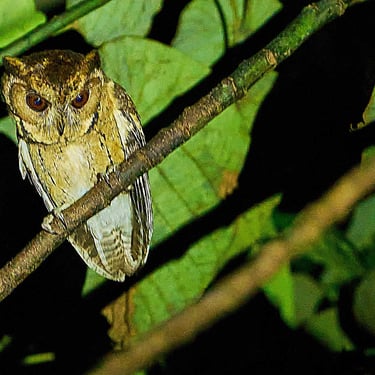
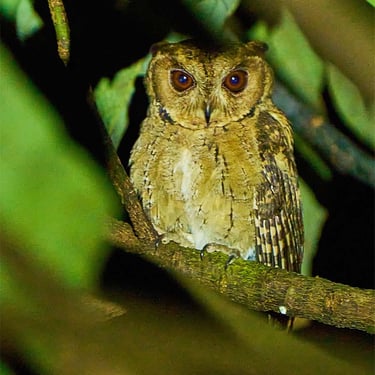
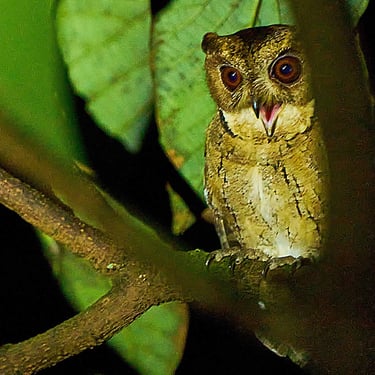
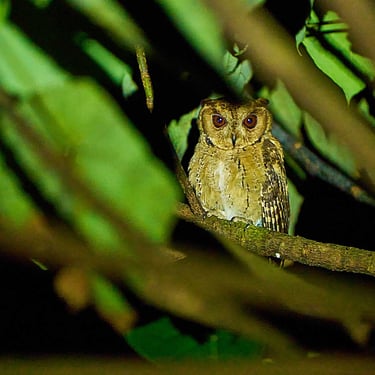
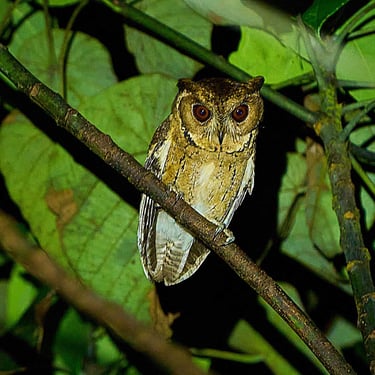
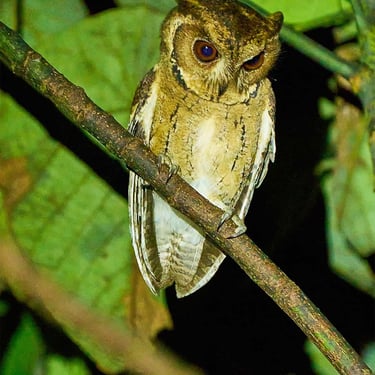
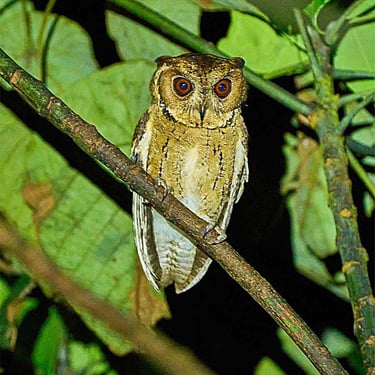
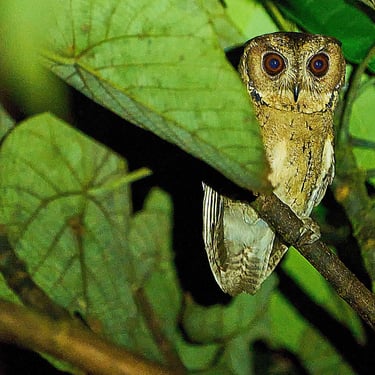
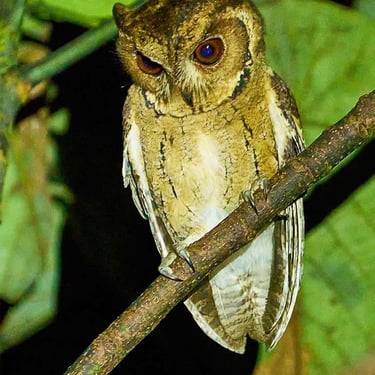
You’ve seen the photos, the eyes are not yellow. It was such a WTF moment for me when I caught him face to face that night. I had sketchy internet throughout my trip in Maharashtra and was in an actual conundrum if it was the one guy that I met or the species in general who had these dark eyes. I mean it was the Indian Scops Owl after all and I’d seen other Scops Owls in India. Well, you never know till you see for yourself and now I know better. Those red / brown eyes make my guy a better hunter at night than his yellow eyed cousins. I’d seen exotic brown and orange eyed owls in photos and videos of domestics on Instagram from other parts of the world. Well, turns out that darker eyed owl species are found in this part of the world as well. I’d just been seeing them during the day when they have to squint as they are more sensitive to light.
Those dark eyes also make my guy more difficult to find once he changes perches. He just camouflages a lot better cause the dull brown / red doesn’t give him away as much as the bright, reflective yellow on his cousin’s eyes does when you’re looking for him with light. In fact, all of the colours and patterns on my guy here blend in with the trees that he usually hangs around at beautifully especially at night. How does this happen in nature? Well, we assume that slow alterations in a species with the passage of time through generational change helps a creature better adapt to its environment and leads to the development of the best version of that species for that environment. So basically, these guys have preferred to be out more at night and hence developed these traits in comparison to their cousins.
Survival of the fittest is the corollary to the theory which ensures that the evolutionary routes that don’t adapt well enough to the said environment are just exterminated in time by predation. Personally, I feel that the whole theory on this one borders around guess work because firstly, we have not yet recorded major environmental change which would turn this whole theory on its head. How much did the Younger Dryas change owls globally? Secondly, how much change are we seeing in the common species that we know well since we started writing this stuff down? Guess we’ll actually know when we’ve lived long enough with recorded evidence as our environment has pretty much been stable since we started writing stuff down but a few thousand years is a rather short term as far as natural change is concerned.
Evolution could be such a long game at certain times and a short one out of necessity during others and you just don’t know what effects change in what and if at all. We’ve discovered a mushroom that eats plastic now. We’re seeing the re evolution of bird species that haven’t been recorded in decades. Who’s to say that a Human that thrives in radioactive environments won’t spawn out of necessity? My money is on the successful recording of the after effects of major planetary change on the species of this planet to settle this once and for all if we’re in a hurry. Sure, most of us would probably die but we would know at the end of it cause someone would’ve hopefully remembered to write stuff down this time around.
Coming back to my Indian Scops Owl; everything else except his eyes fit pretty well with his yellow eyed, Scops Owl cousins that I’d seen in the Andamans. He was bold, unabashed and calm about our attention. Guy lives inside the property that has a birding hide. I’ll wager that he doesn’t mind the attention much at all cause the nearby area is all woodland and yet he chooses to live here. In fact the clearing around this property probably gives him a nice perch for predation and that suits him pretty well to go about his business.
At around 25 cms, these guys can get upto being the largest of the Scops Owls and although I’ve been calling him a he, he could just as easily be a female, really. You can’t tell from a distance with these guys. They’re reported from eastern Arabia to the Indian sub continent. Like other owls, they are the sworn enemies of many bird species who tend to mob these guys upon sight. Since my guy prefers to nest in tree cavities, it’s unlikely that he’d go and build a second home though. He’d usually just change roosting locations during the day. His haters aren’t around as much during the night when he operates. These guys come in two morphs, grey, brown and rufous. The ear tufts on these birds aren’t really ears but feathers that stick up on the sides of their heads. Owls in general tend to stick up the feathers around their ears kinda like how dog’s ears lift up when they get alert. This helps direct the sound to their ears while hunting. They hunt invertebrates, insects and small mammals. Like most owls in our country, these poor little birds have been persecuted through the ages for their mythological connection to Goddess Lakshmi and that’s some really sad business that I really hope that we see the end of soon. ( Ref : The Facination And Peril Of Owls In India )
The Indian Scops Owl camouflages pretty well with those different dark eyes and we know that those perform better at night but we don’t really know if that will ensure better overall performance because it makes them complete bystanders to any opportunities that may arise during the day. Other owls who can hunt during the day might just be at an advantage in the long run cause we don’t know really what the long run will bring. Evolution is a multi edged sword so to speak. Seeing this little guy that night cleared up my wrong assumptions about his kind but it also highlighted that we don’t really know evolutionary paths because of our limited data about life on Earth. Overall it was pretty awesome seeing the Indian Scops Owl as the main event after years of noticing his kind just parked around the reserves during the day and discovering his wonderful surprise. There were a few other surprises for me on this trip, but before getting into that, let me get to the next post about the most thrilling sighting of a common species which should be up in a few days.
The next one’s really special for me and I hope that you like it.


© 2026. All rights reserved.