
The Rarely There - Pallid Scops Owl
The Rarely Seen, Pallid Scops Owl
BIRDS
Aniruddha Bhattacharya
9/29/20267 min read
Koyna, Maharashtra
Rarely encountered birds are coveted usually by the birding community and that’s fun because it adds excitement and adventure to the hunt in a new habitat. It also gives people goals, targets and lots of motivation which can only be inspired by some competition and the pursuit of rarity perhaps. Documenting the numbers of species encountered in a habitat is a global competitive sport of sorts among birders and has been a wildlife related activity for many years now. The images and videos from our encounters add another layer of fun, complexity, and technicality as well to this interest and you will find people with so many different personal goals and interests even within a wildlife enthusiast’s group that may be travelling together for a specific reason at a given time. Many enthusiasts only have an interest in specific species and want to understand, observe and record everything about those beasts while there are plenty of others who just do not have any interest in photography and yet love to sit and watch wildlife sightings for hours at an end. I know many that only chase birds and even more who are only fascinated by big Cats. I’m after the pictures mostly myself but then I’ve learnt that I prefer portraits of my subjects and find the details of my subjects themselves more interesting than the habitat in most cases if I can afford it given the conditions, distance, etc. Rarity though, if you ask me could be overrated in this game as what is perhaps rare in one habitat might be very common in another. Access and exposure are key but I’m sure that pretty much all of us feel a quickening of the pulse when we see a beast that we have not encountered before for the first time. That’s what makes us travel for the sightings in the first place and the people who facilitate these excursions know this well. Discovering the cause of the rarity of a specific species is obviously a logical step in understanding the species and the concept itself as far as the natural world is concerned and that’s the road that The Pallid Scops Owl led me down after I met my guy in the images here at Koyna last year.
“It’s very rare Aniruddh, you HAVE to come !” That’s what my naturalist guide in Koyna said as he yanked the car door open and stared at me with a look that said that he would not take no for an answer. See, the thing was that he’d been tracking this bird up and down the mountain on foot, by torchlight and in a pickup truck going up and down the mountain with all of us in tow in another vehicle for two hours now. The Owl would perch; people would try to get to it with their flashlights on and their approach would make the bird fly off which would start the whole process of locating him again. I’d thoroughly enjoyed the hunt from the vehicle but it was a dark night and given my cane aided mobility, I’d decided that it’d be best to not risk ruining the rest of the trip by venturing into an unknown mountain, in the dark with my cane in one hand and camera in another so I’d hung back during most of the treks into the mountains and meadows of Koyna that night this far. Id’ve managed the treks without the camera but that was just not an option for me. The Owl had relented finally it seemed though and was taking a breather while the rest of our group found their way to him as well. He’d perched furthest from the road this time around and there was no way for me to make it there with both hands occupied. On his part, my host was adamant on getting me across to the bird and gave me examples of other guests whom he’d helped get across difficult terrain to convince me and so I handed him my prized kit and followed along on the trek which was actually easier than I’d expected it to be once we’d gotten past the sandbank at the side of the road for which I needed a free hand to get across. It then took us around 10 minutes or so, and that’s how I met this supposedly “rare” Pallid Scops Owl in a little field, beside the woods of Koyna on a moonless night and after quite the little adventure to get to him.
The Pallid Scops Owl is a migratory species and that’s one of the traits that makes this species a rare sighting in India. It’s the only migratory Owl that I’ve met so far actually, and I had no idea that Owl species migrate as well until I met this little guy. These guys along with the Short-Eared Owls are the only two migratory Owl species that visit India during the winters. These guys migrate from Western and Central Asia, into parts of western India briefly and sightings have been reported from Gujrat, Madhya Pradesh, Rajasthan and a rare sighting from Kerela has also been documented. Our guy in the photos here is in Maharashtra and although I’m pretty sure that he doesn’t care much about our state demarcations, my host’s excitement about this little guy is justified given that this species is rarely found in Maharashtra usually. His kind are rarely ever “seen” in the current habitat that he is in and that’s how rarity often works with bird sightings except in the case of nearly extinct species. That said though, these guys are known to visit parts of the Western Ghats although in very small numbers usually and the chances of encountering one at night are usually very slim. We were lucky because our hosts had locked onto this specific guy recently.
EBird, the international birder’s resource currently reports 2753 reported observations of this species globally. In comparison, it reports 29256 observations of the resident Indian Scops Owl. In fact, 2753 is a pretty low number as far as reported observations of a species go but we are dealing with a nocturnal bird who’s only in any habitat for a limited period of the year and we must remember that some animals just inherently have smaller populations. The conservation status of the species is of “least concern” which basically means that the population seems to be stable as per the IUCN red list. These guys obviously seem to have a stable population and yet, they’re rarely there. The twist in the tale of this species lies perhaps with its sister species, The Eurasian Scops Owl whom they share a resemblance with. These species are often mistaken for each other although they do not share habitats at all. The Eurasian Scops Owl ranges North of the territory of these guys and their numbers are a lot higher than of their Pallid cousins. Both these species are migratory and yet, the Eurasian Scops Owls live and migrate parallelly higher up on the world map in comparison to these guys. Western and Central Asia is harder terrain in comparison to further north on the world map and that kinda explains the population difference between these species and pretty much ties off the reasons for the said “rarity” of the Pallid Scops Owl. They’ve always probably had lower populations because of their lifestyle choices as a species and that’s just how it is with these guys .
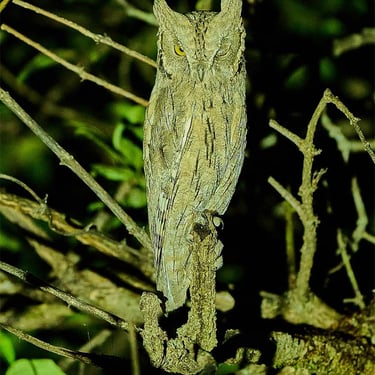
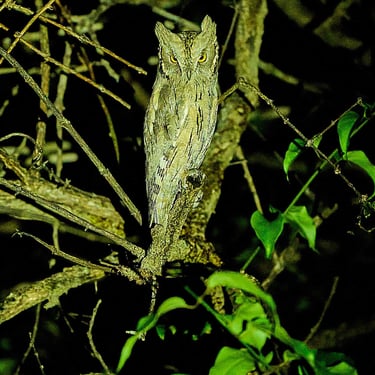
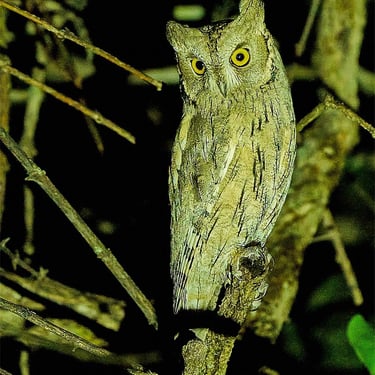
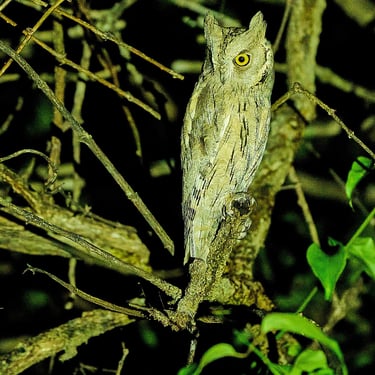
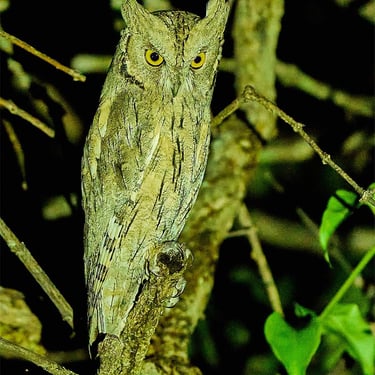
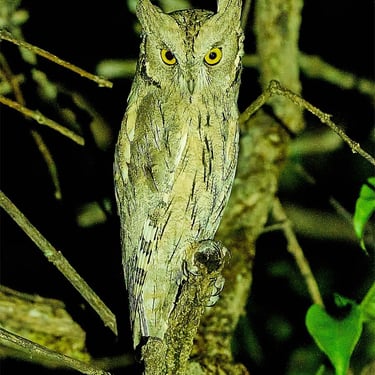
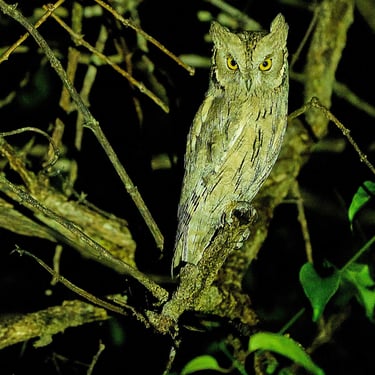
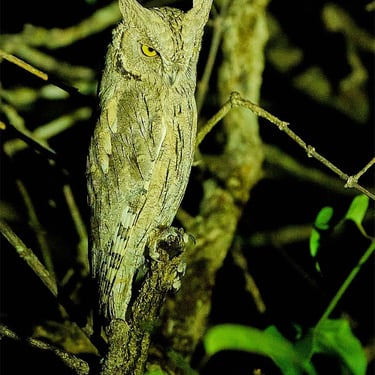
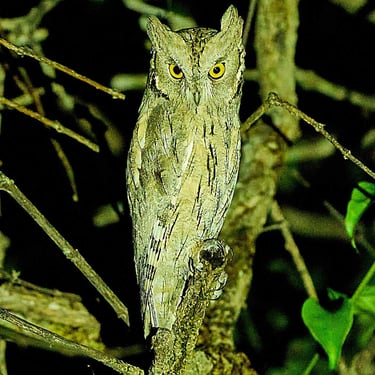
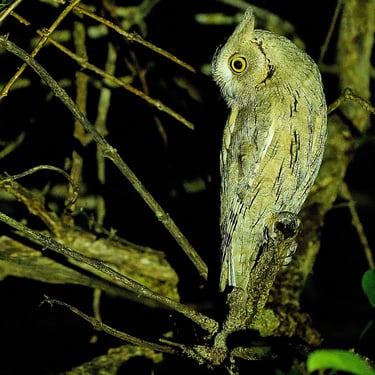
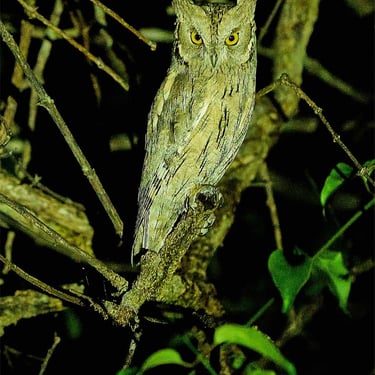
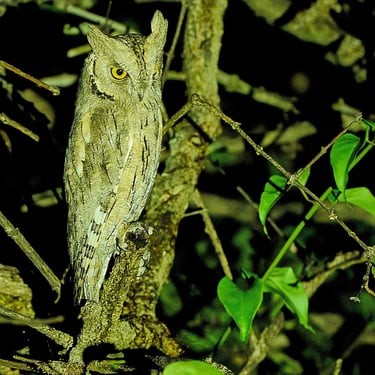
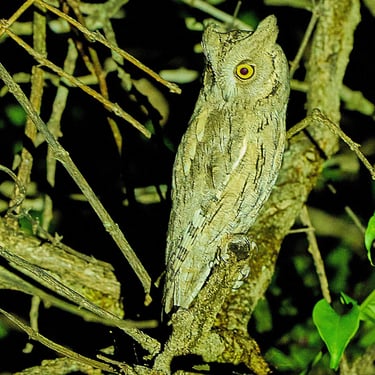
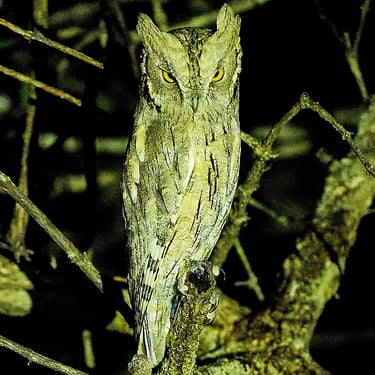
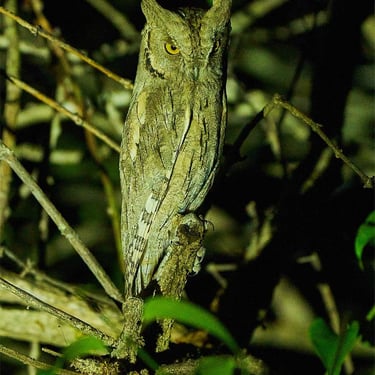
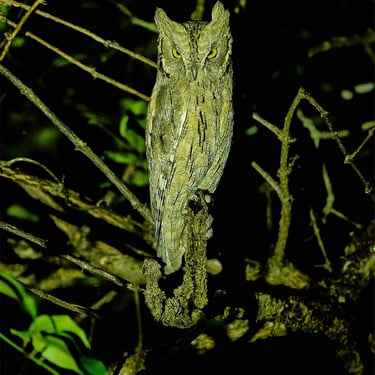
My guy was pretty chilled out when I got to him and you wouldn’t have guessed that this was the same little bird that had made us run up and down that hillside for two hours straight if you observed his behaviour while perched confidently a few metres from us. I’ve seen many owls who change perches and give you the run around after contact’s established but this guy greeted me with a wink as you can see in Pic : 1 and just sat about with what looked like a mischievous smile to me in Pics : 3 & 5. He wasn’t really trying to blend in with his background cause he stayed away from the clutter of the branches behind him and thicker woodland started a few hundred meters to his side where the field ended. It was almost as if as he was comfortable with us at that location which we obviously were very thankful for given the initial chase. He was the star of the moment who just sat there and took the attention in without giving any one of us any undeserved special stares. I couldn’t get him to change the position of his gaze even despite all my attempts at catching his eye and this little dude pretty much let us know who the boss of it was throughout the little time that we were with him before we headed back to the cars cause he made it pretty clear that we were not getting any further action from him. Having seen and recorded this guy the best that we could given his attitude, I don’t think that any of us were complaining much about the events of the night either. It was a pretty fun little adventure after all and we'd scored some images at least. I didn't know that Owls have independent control of their pupils and this little guy taught me that this trait exists in real time as you can see here in all the images where he is looking at the camera. He refused to look around despite my attempts but kept changing the size of his pupils to control light entering his eyes which enabled him to keep an eye on all of us together from his high vantage point. Konya had been good to us on our first day and night and we were looking forward to another morning of adventures before we headed back to Mumbai and beyond.
Meeting this Pallid Scops Owl in Koyna was special because I do not meet many rarely seen creatures usually cause that’s not one of my motivators for picking destinations to visit for wildlife. The adventure that this little guy put us through though is one that I will always remember for sure cause the pictures from the sighting will be around to remind me that I have this awesome story to go with them and that’s what is good for me. The encounter also opened my eyes to the control that Owls have on their pupils, the migratory nature of some owls and the reasons for the rarity of certain creatures and I’m certain that this learning will help me understand a lot else in the future if I keep at this journey. Rarity is subjective when it comes to the huge spectrum that we’re dealing with when we talk about the species on this planet. Figuring out why for yourself is always fun as well and kinda like solving a puzzle within your area of interest. Maybe I should start digging about a few other rare animals that I have encountered. In fact, maybe I will. Who knows what else I could find?
© 2026. All rights reserved.