
Beyond The Party Trick - Eurasian Hoopoe
The Differently Evolved Eurasian Hoopoe
BIRDS
Aniruddha Bhattacharya
8/18/20267 min read
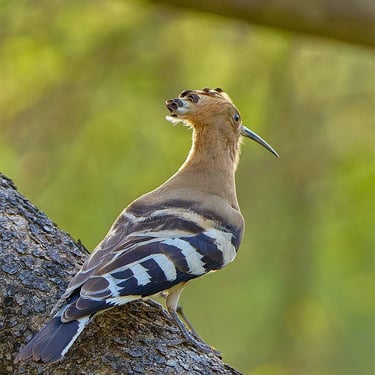
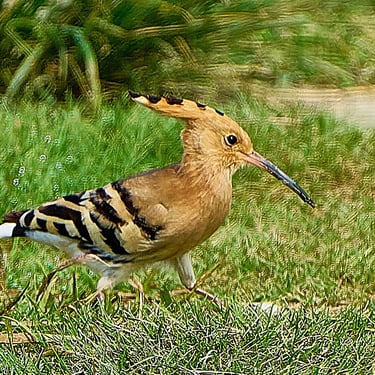
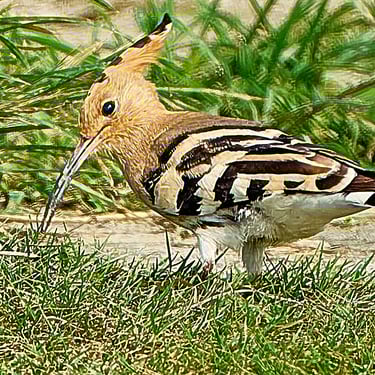
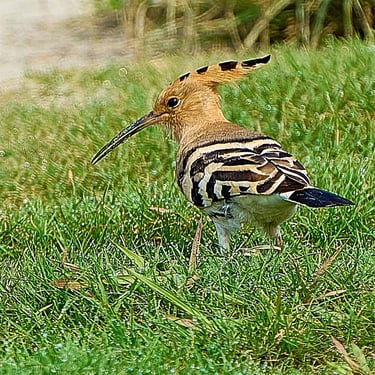
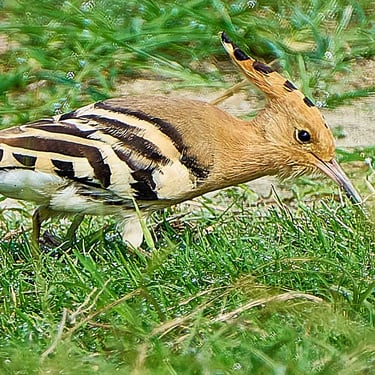
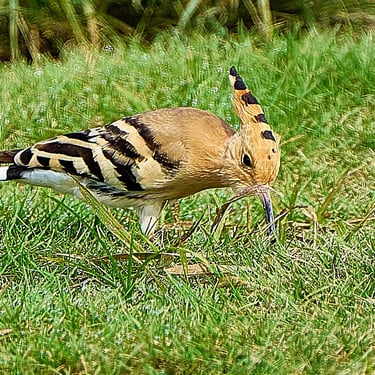
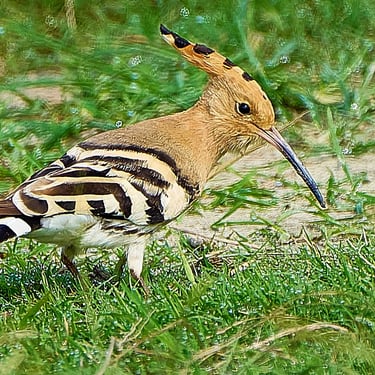
Pics : 1 - 2 = Eurasian Hoopoe ; Jhalana Reserve Forest | Pics : 3 - 16 = Eurasian Hoopoe ; Manas National Park
Wouldn’t it be kinda cool if you could control your hair like some of your other parts? Now, I know that some of us would definitely love to be able to do that but it’s a talent that’s sadly been bestowed only on a handful of avians and among them, the Eurasian Hoopoe is the only recipient of the gift who we can encounter in our habitats around India. My previous post highlighted how the presence of the crest on the Himalayan Black-Lored Tit makes that species stand out in general and also gives them more “attitude” in comparison to others in their family. Well, my guy in the spotlight today has a crest and he can also fan out or bunch up that crest either intentionally or instinctively and that party trick makes him very different from all the other crested birds out there who themselves stand out because of the presence of the crest in the first place. The fanning out of the crest is a pretty neat trick by itself that I’ve yet to witness myself but that isn’t the only thing that makes my guy different. He’s got a whole bag of specialities that make his kind stand out as the last remaining members of a family of birds who evolved just a little differently but the way they look is only the most obvious factor that makes them unique. You cannot mistake a Hoopoe for any other bird cause it’s a Hoopoe, silly. They’re cinnamon and zebra coloured all at once and sport a crest that they can fan out when surprised like cartoon characters. You just don’t see that every day no matter where you are on the planet and they make quite the first impression always.
The first pictures that I scored of one of these guys was at Jhalana Reserve Forest in Jaipur ( Pics : 1 – 2 ) but that wasn’t my first run in with the species cause I remember that I already knew how to pronounce their odd name by then and identified my guy who you see in the pictures here for my driver when I asked him to stop. It’s really odd though that I just cannot seem to recall where and when I learnt their name although I’m pretty sure that it obviously was on one of my first trips to the wildernesses and on the lookout for wildlife. My introduction was a missed opportunity probably but the name stuck cause these unique birds are not easy to forget as I was telling you a little earlier. The sighting at Jhalana was under beautiful conditions when the forest just seemed to come alive with bright colours after the rain as I’ve written about in “The Dazzling Forest” and my guy was one of the subjects who opened up my eyes to the brilliant effects that reflection of light on rainwater can have on our images from the forest.
As their name suggests, these guys are found in Europe, Asia and they’re also residents of Sub-Saharan Africa as well. The southern part of Africa is the range of the African Hoopoe which has darker, chestnut red coloured plumage and a higher degree of sexual dimorphism between the genders of the species. There are only three living species of Hoopoes and the Eurasian Hoopoe has the largest range and population among them while the Madagascar Hoopoe is found exclusively in the island of Madagascar and has the lowest numbers. They are on the larger side of medium sized birds who can get upto 32 cm and can weigh upto 90 gms. They have very distinctive long, tapered bills that remind me of fencing swords and knowing me, you probably know about my fright of and opinion on birds with such long, sword like bills by now as well. Yeah, I’ll stay away, thank you but the temptation to startle one of these guys to make him fan out that crest for a picture has crossed my mind and I’ll probably give that a go from the security of a vehicle close to the subject which I didn’t have when I ran into the species on my last two meetings with em in Manas National Park and Guwahati. They’re pretty confident and not skittish like smaller birds and getting perched images of these guys is usually not difficult even at Aperture Priority. They aren’t in a rush usually and are pretty confident around Humans when perched or foraging on the ground.
The Hoopoe evolved slightly differently like I said earlier and that’s not limited to their crests alone and you realize that the minute you see one of these guys in flight. They fly like butterflies. Unlike most birds that have tapered or pointed wings, Hoopoes have very broad, paddle like, rounded wings that close halfway. This shape provides massive lift at lower speeds but lacks the streamlined slicing mechanism needed for continuous smooth gliding. Their flight path dips and rises unpredictably kinda like how GOT imagines the flight path of the Dragons in that series franchise but in all actuality, it mostly resembles the fluttering of large insects from the real world. Their irregular flight pattern does not dissuade these guys from migration though and northern populations of these birds fly thousands of kilometres on long distance seasonal migrations between their European and Asian breeding grounds and their tropical African or Indian wintering areas. They are well capable of continuous nocturnal flight lasting upto 28 hours at a stretch. These guys have been spotted flying across the Himalayas even with one recorded sighting at an altitude of 6400 meters during a Mount Everest expedition.
These guys are mostly insectivorous and have evolved those fencing swords attached to their faces to get to their prey. My recent run ins with the species at Manas and in my hometown of Guwahati were sightings where I could watch these guys carefully walk around while they pushed their bills into the ground after careful inspection. The modus operandi here is to stick the bill in and open the bill in the dirt or sand to grab and yank out their prey. These guys then smash their prey against rocks to remove wings and legs before swallowing. They get pretty engrossed in the business alright and won’t even care if you’re a little bit away from where their attention is at and foraging time is probably a great opportunity to catch images of these guys going about their business if you can work out a distance to your subject where the images are not ruined by a steep angle with regards to your shooting position. Further away is good for a better angle but then distance will take away detail from your images so it’s pretty much a trade off where a longer lens and a sensor with more MPs helps a lot in the making of a presentable final image after post process.
Male Hoopoe’s are known for striking physical postures during the courtship phase every season when they call, strike poses, fan out those controllable crests and even bring food gifts to the females they are courting. Once bonded, the seasonal pair use natural holes like tree cavities, rock crevices or wall cracks for their nests. They do not bring in twigs, grass or leaves to build or line their nests and instead choose to lay their eggs on bare wood or dirt. The female cleans up old debris, etc from the chosen nest at most before laying her clutch of 4 to 12 eggs. The female then incubates the eggs alone while the male takes over the responsibility of bringing food for the female for the 15-to-18-day incubation period after which the eggs hatch one at a time and not altogether.
Giving off odour as a defence mechanism is usually a mammalian strategy often seen in rodents like skunks and civets like the Asian Palm Civet who I met recently in Pobitora and wrote about in “See you; see me”. Well, Hoopoes have evolved their own version of the defence strategy where the breeding females of the species secrete a very foul smelling, dark, oil like preen gland secretion that they smear onto their feathers and eggs. This antimicrobial paste protects the eggs and chicks from harmful bacteria and also gives out an odour that smells like rotting flesh that larger predators stay away from giving the mother and her nest the security they need while the father Hoopoe is off getting food for the family. Young Hoopoe chicks can also direct projectile streams of feces at intruders and droppings are allowed to build up in the nest cavity to keep the place smelling rank and unhospitable. The intense smell vanishes shortly before the young birds are ready to leave the nest though and adults do not smell this way outside of the breeding season.
Hoopoes are different alright and it’s not all about how they look and our ancestors noticed and acknowledged them in legends and religion as well. In the Qaran, the Hoopoe acts as a clever scout and diplomat for King Solomon. Persian poetry sees the Hoopoes as symbols of wisdom, piety and spiritual leadership. Greek mythology recounts how King Tereus was transformed into a Hoopoe as a divine punishment for horrific crimes, with his prominent crest mirroring his regal past and mournful call showing regret. In France, hearing a Hoopoe’s call was believed to signal a plentiful grape and wine season while Scandinavian and Baltic folklore depicted the bird as a harbinger of war or pestilence. Even ancient Egyptian temple and tomb walls have these guys depicted in them and they were used in hieroglyphics as a symbolic code for the devotion of a child as the successor to and heir to his father.
Yeah ! Hoopoe’s are special and it goes a lot further than their unique look which includes that famous crest. It’s all good to know really but man, I just can’t get over that fact that I still haven’t scored a well-lit image of one of these guys with the crest fanned out with the subject looking at me. Another one for the wish list I guess and more the reason to want to run into them again. There’s a lot to the Hoopoe beyond the party trick for sure and I’m sure that it’ll all be a little sweeter when I’ve capped the party trick once and for all at least. At least now I know that I have to find one perched and relaxed close by and have to try and startle him with my camera ready in the vehicle.



© 2026. All rights reserved.